Signs Your Basement Bedroom Isn't Egress-Compliant
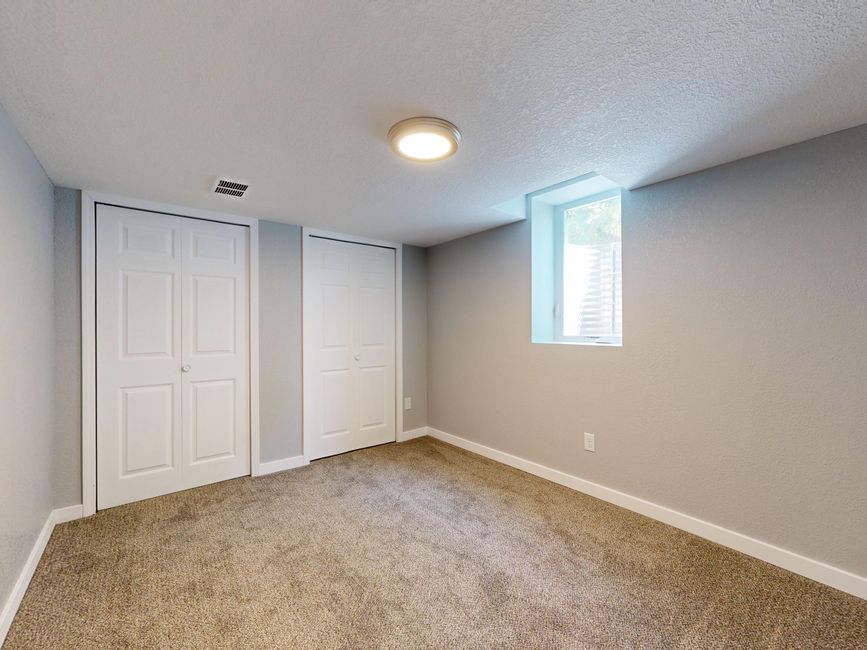
A finished basement room that's being used as a bedroom — whether that's a guest room, a teenager's room, or a rental unit — has to meet Wisconsin's egress window requirements, not just look and feel like a bedroom. A surprising number of older basement conversions were finished before current owners bought the home, or were finished informally without confirming code compliance. Here are the general signs worth checking for, at a homeowner level, along with why each one matters.
The window looks small for the room
The most direct sign is the window itself. Wisconsin's Uniform Dwelling Code sets a specific minimum size for an egress opening: SPS 321.03(6)(b)1. requires a nominal net clear opening of at least 20 inches by 24 inches. If a basement bedroom's window looks noticeably smaller than that — a narrow slider, a small hopper-style window, or a window that clearly wasn't sized with egress in mind — that's a sign worth following up on. Measuring the actual clear opening (not the frame, and not the glass alone) against that figure is the way to check it directly.
The window sits high on the wall
Sill height is the other half of the code target. SPS 321.03(6)(d)1. requires the low point of the clear opening to sit no more than 60 inches above the finished floor. A window that sits noticeably higher than that — especially one that would require standing on furniture to reach — is a sign the room may not meet the sill-height requirement, independent of whether the opening size is otherwise fine.
The window doesn't fully open, or isn't operable
An egress window has to actually function as an exit, not just exist as an opening. A basement window that's painted shut, blocked by a storm window or security bars that don't release from inside, or that only opens a few inches, doesn't serve as a second exit even if its overall dimensions look reasonable. This is a sign that's easy to check directly and easy to overlook, since a window can look compliant from a distance while not actually being usable as an exit.
There's no window well outside a below-grade window
If the window sits below the surrounding grade — which is typical for a basement — it generally needs an exterior window well or areaway to create usable open space outside the opening. A below-grade window with no well outside it, or with a well that looks too narrow or shallow for the window, is a sign the exterior side of the egress path hasn't been addressed.
The room is used as a bedroom, but the window was never addressed
Sometimes there's no obvious visual sign at all — the window might look reasonably sized — but the room is being used as a bedroom in a home where the basement was finished for general living space, not specifically evaluated against the bedroom rule. Wisconsin code requires a basement or ground floor used for sleeping to have at least two means of exit (SPS 321.03(5)(b)1.), and specifies that a bedroom's second exit has to be a code-compliant egress window (SPS 321.03(5)(b)4.d.). If a basement room is functioning as a bedroom and nobody has specifically confirmed the window against that rule, it's worth checking rather than assuming a finished-looking room is automatically compliant.
No record of a permit for the conversion
Whether a permit was required for the original basement finishing or bedroom conversion depends on the municipality — SPS 320.09(2)(b)1. frames this as applying "when required by local ordinance" rather than as a single statewide rule. If there's no record of a permit for a basement bedroom conversion, and no way to confirm the window was inspected and approved as part of that process, it's a reason to have the window checked directly rather than assuming it was done to code. Confirm requirements with your municipality.
Something outside the window is blocking it
Even a properly sized, properly operating window can stop functioning as an emergency exit if something outside is in the way. A window well cover that can't be opened or released quickly from inside, snow or yard debris built up against the well, or storage and landscaping crowded against the well's opening can all turn an otherwise compliant window into one that doesn't actually work as an exit in practice. This is a sign worth checking seasonally, not just once — a window well that's clear in summer can be buried by winter.
What a compliant setup generally looks like
Put together, a basement bedroom window that meets Wisconsin's egress requirements generally has an opening that clearly looks large enough to climb through without squeezing, a sill that's within easy reach from the floor, a window that opens fully and easily by hand, and a window well outside (if the window is below grade) that's clear, appropriately sized, and unobstructed. If any one of those doesn't describe the window in a room being used as a bedroom, it's worth having it checked rather than assuming the rest make up for it.
What to do if you notice one of these signs
None of these signs are a certain diagnosis on their own, and none of them require guessing at measurements from memory. The straightforward next step is to have the window and the room evaluated directly against the code target above. Whether the fix turns out to be enlarging the existing window — see basement window enlargement — or something else the evaluation surfaces, requesting a quote through this site is the way to get a specific answer for that room. The full code breakdown behind an egress window is also covered on the egress window installation page.